It seems like we spend all winter trying to get our home humidity levels up and then all summer trying to get them down.
What exactly is humidity and the dew point and why does it matter?
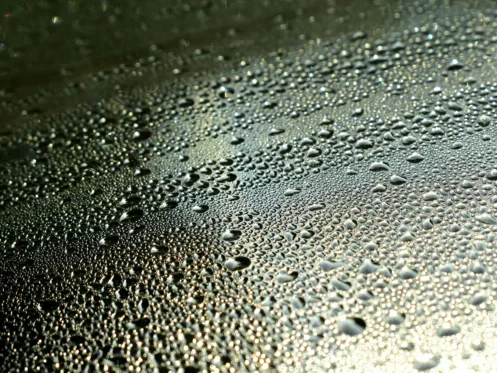
Relative humidity is the ratio (expressed as a percentage) of the amount of moisture in the air to the maximum amount that can be present at that temperature. The dew point is the temperature at which a given sample of air will have a relative humidity of 100%, or the saturation temperature. All three of these measurements – temperature, humidity, and dew point – are bound together and determine what is comfortable and what is not.
Warm air can hold more water vapor than cool air. Relative humidity and dew point determine the saturation. When the relative humidity is less than 40% it feels dry, when it is above 80% it feels moist. The higher the dew point in relation to the humidity, the more uncomfortable the air feels.
Thus, when the dew point is over 65° and the humidity is over 80% (as it has been lately) it becomes uncomfortable.
The optimum combination for human comfort is a dew point around 60° or lower, a relative humidity level between 50% and 70%, putting the temperature around 75° F.
The Comforts of an Air Conditioner
Air conditioners cool homes by removing heat and moisture from the air. High humidity in your home can cause moist and clammy air, foggy windows, or a musty odor (coming from dampness around the home.)
The air conditioning system should effectively remove moisture from the air.
Bigger Not Always Better
Many people think that a larger and more powerful AC unit will cool the home more effectively. However, this is not necessarily true. If the AC is larger than needed it will not be able to remove the moisture efficiently and the humidity levels will remain high. This is because the unit will not need to run as often, as it is more powerful, thus the unit will not remove the humidity as it rises in the home. This makes it crucial to have an AC unit that suits your home.
When the AC Just Isn’t Cool Anymore
If your air conditioner is older, not sized correctly for your home, or just isn’t working properly it’s time to consider a new system.
While a new system may cost more than you want to spend, it will save you money in the long run. Having a reliable heating and air conditioning system that works properly, efficiently, and capably will save you on your monthly bills and unexpected repairs, as well as keep your home comfortable.
We Can Help
If you aren’t sure how well your air conditioning system is working, let our professionals help. We provide free, in-home estimates to make sure your system is working the way it should to keep you and your family cool during these hot summer months. Contact us to schedule an appointment.
Frequently Asked Questions
What is the dew point, and why does it matter for comfort?
The dew point is the temperature at which air becomes saturated and reaches 100% relative humidity. Temperature, humidity, and dew point work together to determine how comfortable the air feels. The higher the dew point is compared with the humidity, the more uncomfortable the air feels.
What humidity level and dew point feel most comfortable?
Many homeowners are most comfortable with a dew point around 60° or lower, relative humidity between 50% and 70%, and a temperature near 75°F. Air feels dry when relative humidity falls below 40%. It starts to feel uncomfortable when the dew point is over 65° and humidity is over 80%.
Why does my home feel humid even when the AC is running?
An air conditioner cools your home by removing heat and moisture from the air, so it should also bring humidity down. If your home still feels moist or clammy, or you notice foggy windows or a musty odor, the system may not be removing moisture effectively. If you experience this regularly, it’s an indication that the AC may be sized wrong for your home, or it may not be working properly.
Is a bigger air conditioner better at removing humidity?
No. A unit that is larger than your home needs cools the air quickly and then shuts off, so it does not run long enough to pull moisture out of the air. Humidity stays high even though the temperature drops. An AC that is sized to your home removes moisture more efficiently.
How do I know if my AC is still the right system for my home?
Consider a new system if your AC is older, is not sized correctly for your home, or is no longer working properly. A reliable, properly sized system keeps your home comfortable and can reduce unexpected repairs. A TR Miller technician can evaluate how well your system is working and explain your options.
Author