
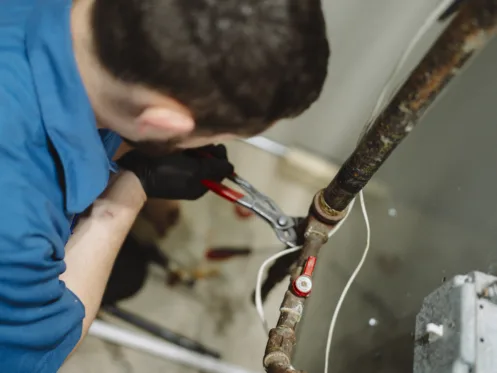
Weak water pressure is one of the most frustrating plumbing problems a homeowner can face — and one of the most commonly misdiagnosed. A slow shower, a kitchen faucet that barely fills a pot, or a washing machine that takes twice as long to complete a cycle are all signs that something is wrong with your home’s water delivery system. What many homeowners don’t realize is that low water pressure is rarely just an inconvenience. In most cases, it’s a symptom of an underlying issue that will get worse — and more expensive — if left unaddressed.
Understanding what causes low water pressure in your home is the first step toward resolving it correctly. This guide walks through the most common causes, how to identify them, and when it’s time to call a licensed plumber rather than attempting a DIY fix.
What Is Considered Normal Water Pressure?
Before diagnosing a pressure problem, it helps to know what you’re measuring against. Residential water pressure is measured in pounds per square inch (PSI). The standard range for a properly functioning home plumbing system is between 40 and 80 PSI, with most plumbing engineers and code authorities recommending a target of around 60 PSI for everyday household use.
Pressure consistently below 40 PSI will noticeably affect fixture performance. Pressure above 80 PSI places excessive stress on pipes, joints, appliance connections, and water heater components — a condition that is just as problematic as pressure that is too low.
You can measure your home’s water pressure with an inexpensive pressure gauge that threads onto any hose bib. If your reading consistently falls outside the 40–80 PSI range, that number alone justifies a professional plumbing inspection to identify the root cause before fixtures or pipes sustain damage.
The 7 Most Common Causes of Low Water Pressure
1. Partially Closed Main Shutoff Valve
The simplest and most overlooked cause of whole-house low water pressure is a main shutoff valve that was never fully reopened after a repair or a water emergency. The main shutoff is typically located near the water meter — either in the basement, a utility room, or at the exterior foundation of the home. If the valve is even slightly closed, it restricts flow throughout the entire system.
Check this first before assuming a more serious problem. Turn the valve fully counterclockwise until it stops. If pressure improves immediately, the fix required zero tools and zero cost.
2. Failing or Incorrectly Set Pressure Reducing Valve (PRV)
Most homes built after the 1980s have a pressure reducing valve — a bell-shaped device installed where the main water line enters the house. The PRV is factory-set to deliver water at a safe, consistent pressure regardless of fluctuations in the municipal supply line.
PRVs have a service life of approximately 10 to 15 years. When a PRV begins to fail, it can cause one of two problems: it may restrict flow and cause low pressure throughout the house, or it may fail open and allow high-pressure water into your plumbing system unchecked. Both conditions require professional plumbing repair — a failing PRV cannot be reliably adjusted back into service and should be replaced.
A licensed plumber can test PRV output with a calibrated gauge, confirm whether the valve is functioning correctly, and replace it if necessary — typically in a single service visit.
3. Mineral Scale Buildup Inside Pipes
In the Chicago western suburbs, hard water is a known and measurable issue. Water from municipal supplies in Will, DuPage, Kane, and Cook counties carries elevated concentrations of calcium and magnesium minerals. Over time, these minerals precipitate out of solution and deposit as scale on the interior walls of pipes — particularly in older galvanized steel lines.
As scale accumulates, the effective interior diameter of the pipe shrinks, increasing flow resistance and reducing pressure at fixtures. This process is gradual and often goes unnoticed until pressure has dropped significantly. Galvanized steel pipes installed before 1990 are particularly susceptible because they corrode internally as well, creating a rougher surface that accelerates scale adhesion.
A plumbing inspection using a camera system can assess the interior condition of your pipes and help determine whether descaling, section replacement, or full repiping is the appropriate corrective path.
4. Active Pipe Leak
A significant leak anywhere in the supply system diverts pressurized water away from fixtures — and the further the leak is from the fixture, the more pronounced the pressure drop. Leaks inside walls, under concrete slabs, and along the main lateral line between the street and the house are particularly common sources of whole-house pressure loss because they can discharge large volumes of water undetected for extended periods.
Signs that a hidden leak may be responsible for your pressure problem include:
- Unexplained increases in your monthly water bill
- Warm or wet spots on floors or walls
- The sound of running water when all fixtures are off
- Soft or discolored patches in the lawn above the lateral line path
If you suspect a hidden leak, this is a situation that warrants a call to an emergency plumber near me — active leaks cause structural damage to framing, flooring, and foundations that compounds quickly when left unaddressed. TR Miller’s licensed plumbers use electronic acoustic leak detection to locate hidden leaks without destructive demolition.
5. Corroded or Deteriorated Supply Pipes
Homes built before 1970 frequently have original galvanized steel supply piping. Unlike copper or PEX, galvanized steel corrodes from the inside out over decades of use, progressively narrowing the interior diameter and reducing flow capacity. At advanced stages of corrosion, the pipe wall can become so compromised that sections collapse under normal operating pressure.
If your home is older and experiences pressure problems that cannot be resolved through valve adjustment or PRV replacement, the piping itself may be the limiting factor. A full or partial repipe with PEX or Type L copper eliminates the restriction permanently and restores full flow capacity to every fixture in the home.
6. Water Heater Flow Restriction
If low water pressure affects only your hot water lines — cold water fixtures run at normal pressure while hot water fixtures run weak — the problem is likely isolated to your water heater or the supply lines immediately connected to it.
Traditional tank water heaters can develop internal scale accumulation on the inlet screen and internal components, particularly in hard water areas. The shutoff valves on the inlet and outlet connections of the water heater are also a common source of restriction if they were partially closed during a past service call and never fully reopened.
Check both shutoff valves on your water heater first. If both are fully open and the hot water pressure problem persists, a water heater flush or a professional evaluation of the inlet screen and internal components is the next step.
7. Municipal Supply Pressure Issues
Not all low water pressure problems originate inside the home. Municipal water systems experience pressure variations due to peak demand periods, main breaks, seasonal changes in reservoir levels, and aging infrastructure. If your neighbors report similar pressure issues simultaneously, the source is almost certainly the supply main rather than your home’s plumbing.
Contact your local water utility to report the issue and ask whether any known main work or pressure adjustments are affecting your area. If the utility confirms normal supply pressure but your home’s fixtures still run weak, the restriction exists within your property and a licensed plumber should evaluate the system.
Single Fixture vs. Whole-House Pressure Problems
One of the most useful diagnostic distinctions a homeowner can make before calling for service is whether the pressure problem affects a single fixture or the entire house.
Single fixture low pressure is almost always caused by a clogged aerator or showerhead — mineral scale and debris accumulate in the small screen at the tip of faucets and showerheads and restrict flow without affecting system pressure at all. Remove the aerator, soak it in white vinegar for 30 minutes, and reinstall. If pressure returns to normal, the problem is solved.
Whole-house low pressure — where every fixture runs weak simultaneously — points to a system-level cause: a partially closed valve, a failing PRV, corroded pipes, or an active leak. These require professional diagnosis and repair.
Isolated to hot water only — points to the water heater circuit as described above.
Matching the symptom pattern to the right cause before calling for service helps your plumber arrive with the correct tools and expectations, and typically results in a faster, less expensive resolution.
When to Call an Emergency Plumber Immediately
Some water pressure situations do not warrant a wait-and-see approach. Call for emergency service if you observe any of the following:
- Sudden complete loss of water pressure with no known cause — this can indicate a main break or a catastrophic pipe failure
- Visible water damage on walls, ceilings, or floors coinciding with pressure loss
- Discolored water alongside pressure loss — this indicates pipe corrosion or contamination that poses a health risk
- Pressure loss after a recent hard freeze — frozen pipes that thaw can fracture, producing leaks that are not immediately visible
If you’re searching for an emergency plumber near me after any of these situations, TR Miller dispatches licensed plumbers across the Chicago western suburbs seven days a week, including evenings, with fully stocked service trucks to resolve emergency plumbing failures on the first visit.
How TR Miller Diagnoses Low Water Pressure
When a TR Miller licensed plumber responds to a low water pressure call, the diagnostic process follows a systematic sequence rather than guessing at the most likely cause:
- Pressure gauge measurement at the main — establishes baseline PSI and confirms whether the restriction is before or after the PRV
- PRV test — verifies output pressure against the factory setpoint
- Valve inspection — confirms all isolation valves throughout the system are fully open
- Hot vs. cold comparison — isolates whether the problem is supply-side or water-heater-side
- Acoustic leak detection — rules out hidden leaks as a contributing factor
- Camera inspection if pipe corrosion is suspected — documents interior pipe condition and identifies the extent of scale buildup or deterioration
This sequence ensures the repair recommendation is based on confirmed findings rather than assumptions — protecting homeowners from paying for work that does not address the actual root cause.
Frequently Asked Questions About Causes of Low Water Pressure
Q: Can I fix low water pressure myself?
A: Some causes of low water pressure are straightforward DIY fixes — checking that the main shutoff valve is fully open and cleaning a clogged fixture aerator are both tasks a homeowner can handle without any tools or plumbing experience. However, most system-level pressure problems — a failing PRV, corroded pipes, hidden leaks, or scale buildup — require professional diagnosis and repair. Attempting to adjust a PRV without a calibrated pressure gauge, or to repipe a section without proper fitting technique, risks making the problem worse or creating a new leak.
Q: Why does my water pressure drop when someone flushes the toilet or runs the dishwasher?
A: Pressure drops during simultaneous water use are normal to a degree — every fixture draw reduces available pressure at other open fixtures momentarily. However, if the drop is significant (a shower going from strong to barely a trickle when a toilet flushes), it typically indicates that your supply line is undersized for your household’s demand, or that a restriction somewhere in the system is limiting available flow. A plumbing inspection can measure flow rate alongside pressure to determine whether the system is correctly sized for your usage patterns.
Q: How long does a PRV last and how do I know if mine needs replacement?
A: Pressure reducing valves typically last between 10 and 15 years under normal operating conditions. Signs that a PRV may need replacement include whole-house low pressure that cannot be explained by valve position, water pressure that fluctuates significantly throughout the day, or a water hammer (banging pipes) that develops without any obvious cause. A licensed plumber can test PRV output in minutes with a pressure gauge and give you a definitive answer on whether replacement is warranted.
Q: Is low water pressure dangerous?
A: Low water pressure itself is not immediately dangerous, but the conditions that cause it often are. A hidden pipe leak, for example, can cause thousands of dollars of structural water damage long before the homeowner notices a pressure change. Severely corroded galvanized pipes can fracture under normal use. And a PRV that fails open — allowing unrestricted high-pressure municipal water into your home’s plumbing — can rupture flexible supply lines behind appliances and cause significant flooding. Treating low water pressure as a minor inconvenience rather than a diagnostic signal is one of the most common and costly plumbing mistakes homeowners make.
Q: How much does it cost to fix low water pressure?
A: The cost depends entirely on the underlying cause. Cleaning a clogged aerator costs nothing. Replacing a PRV typically runs between $200 and $500 for parts and labor. Repairing a hidden pipe leak varies widely based on location and access — a leak in an accessible basement costs far less to repair than one under a concrete slab. A partial or full repipe for a home with corroded galvanized pipes is a larger project that is best evaluated with an in-home assessment. TR Miller provides upfront pricing before any work begins so homeowners always know the full cost before approving a repair.
If your home is dealing with persistently low water pressure and you’re not sure where to start, TR Miller’s licensed plumbers are ready to help. We serve homeowners across Plainfield, Bolingbrook, Tinley Park, Elgin, and the surrounding Chicago western suburbs with honest diagnostics, upfront pricing, and same-day service availability seven days a week. Whether the fix is a simple valve adjustment or a more involved plumbing repair, we’ll give you a clear assessment before any work begins. Contact TR Miller today to schedule a plumbing inspection or request emergency service — and get your water pressure back where it belongs.
Author